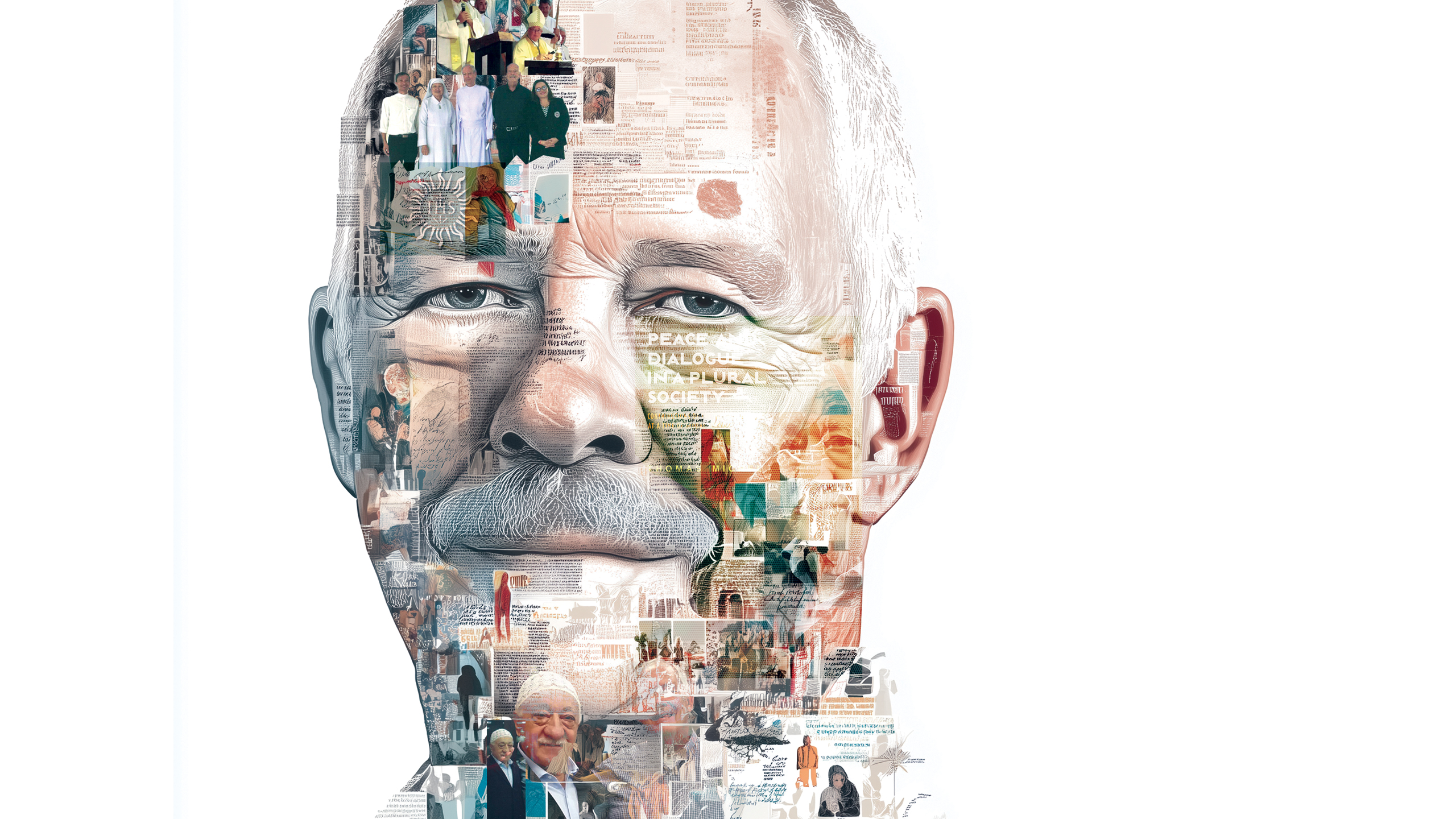
When we look at the lives of Pope Francis and Fethullah Gülen, we encounter two remarkable contemporaries whose journeys began in strikingly parallel times. Born just a few years apart—Jorge Mario Bergoglio in 1936, in Buenos Aires, and Muhammed Fethullah Gülen in 1938, in a small village near Erzurum—these two religious figures emerged from contexts that would profoundly shape their commitment to dialogue. Their deaths, occurring within six months of each other in 2024 and 2025, mark the end of an era in which both men championed interfaith understanding at a crucial moment in human history.
To understand the depth of their commitment to dialogue, we must first understand the zeitgeist of their formative years. Bergoglio came of age in an Argentina marked by deep social inequalities, while his family carried the memory of fleeing fascist Italy in 1929. He grew up in the working-class neighborhood of Flores, witnessing firsthand the struggles of the marginalized. Later, as a young Jesuit priest, Bergoglio would experience the dark years of Argentina’s military dictatorship and the Dirty War of 1976-1983, when thousands disappeared. This crucible of suffering and social injustice would forge his understanding of the church’s mission to the poor and his belief that faith must be lived in solidarity with those who suffer.
Gülen’s Turkey was equally formative, though different in its challenges. Born in the conservative, Sufi-influenced culture of eastern Anatolia, he grew up under the strict secularism of the Kemalist state, where even his mother’s teaching of the Qur’an in their village was technically illegal. The Turkey of his youth was caught between its Ottoman Islamic heritage and the aggressive modernization project that sought to erase religious influence from public life.
This tension between tradition and modernity, between faith and secular governance, became the backdrop against which Gülen would develop his vision of a renewed Islam capable of engaging constructively with the modern world. Working as a state-appointed imam from 1959 to 1981, he navigated these contradictions with remarkable creativity, ultimately enabling the formation of a movement that would establish hundreds of schools worldwide.
What stands out most profoundly in both men is how their unwavering commitment to their respective faiths became not a barrier to dialogue but its very foundation. For Bergoglio, his Jesuit formation and deep devotion to Christ grounded his openness to others. The more authentically Christian he became, the more he could recognize and honor the divine presence in other traditions. Similarly, Gülen’s profound immersion in Islamic spirituality, deeply influenced by Said Nursi’s writings, enabled him to reach across religious boundaries with confidence and humility. Both exemplified a crucial paradox of authentic dialogue: it is precisely those who are firmly rooted in their own tradition who can engage most generously with others. Their interfaith work was not about diluting their convictions but about living them fully.
Nostra Aetate
The Second Vatican Council’s Declaration Nostra Aetate, promulgated in 1965 when Bergoglio was a young Jesuit in formation, opened revolutionary new pathways for Catholic engagement with other religions. This document, which declared that the Church “rejects nothing that is true and holy” in other religions and called for dialogue and collaboration, provided the theological framework that would guide the future Pope Francis. The Council’s teaching that Muslims “adore the one God” and that the Church looks upon Muslims “with esteem” gave official sanction to what would become Bergoglio’s lifelong practice. He absorbed these teachings during his formative years as a seminarian and priest, and they became integral to his pastoral approach.
For Gülen, the decisive intellectual influence was his encounter with the writings of Said Nursi, the Kurdish Islamic scholar whose Risale-i Nur collection reimagined Islamic thought for the modern age. Nursi’s emphasis on the compatibility of faith and reason, his positive engagement with science, and his call for Muslims to contribute constructively to society rather than retreat into isolation provided Gülen with a theological foundation for dialogue. Through Nursi’s lens, Gülen came to understand that reaching out to people of other faiths was not a betrayal of Islam but an expression of its deepest values of mercy, compassion, and service.
Both men shared a profound connection with Pope John Paul II, though in different ways and to different degrees. Francis’s relationship with John Paul was intimate and transformative.
Appointed auxiliary bishop of Buenos Aires in 1992 and made a cardinal in 2001 by John Paul II, Bergoglio worked closely with the Polish pope and absorbed his vision of the Church as a protagonist in the modern world. John Paul’s example of fearless engagement with cultures, his numerous encounters with leaders of other faiths, and his understanding of the papacy as a ministry of dialogue shaped the future Pope Francis profoundly.
Gülen’s encounter with John Paul II was briefer but no less significant. His meeting with the Pope at the Vatican in February 1998 represented a milestone in Muslim-Catholic relations, coming at a time when such high-level encounters were still relatively rare. This meeting occurred in the spirit of Assisi—that groundbreaking gathering in October 1986 when John Paul II invited religious leaders from around the world to pray for peace. The Assisi gathering, though controversial in some quarters, became a defining moment in interreligious relations, establishing what became known as the “Spirit of Assisi.” It demonstrated that people of different faiths could come together, not to compromise their beliefs, but to witness together to the transcendent dimension of peace.
Both Francis and Gülen were uncompromising in their commitment to nonviolence and in their determination to deconstruct the false association between religion and terrorism. After the September 11 attacks, Gülen was among the first prominent Muslim voices to condemn the violence publicly and to insist that such acts violated the core teachings of Islam. Throughout his life, he emphasized that Islam’s name itself, derived from the root for peace, called Muslims to be peacemakers. Similarly, Francis consistently refused to accept any linkage between authentic religious faith and violence. He repeatedly stressed that using God’s name to justify violence is a form of blasphemy. Both men understood that the integrity of religious traditions depends on their capacity to promote peace and human dignity.
At the heart of both men’s understanding of dialogue lies a profoundly simple yet challenging principle: the centrality of love for every human person as beloved by God. For Francis, this is rooted in the Christian understanding of the imago Dei—every person bears the image of God and therefore deserves respect and love. He has spoken movingly about the need to see Christ in the face of the poor, the migrant, the suffering. For Gülen, the Qur’anic teaching that God loves humanity and has honored human beings with dignity shapes his approach to others. In his understanding, which draws deeply from Sufi spirituality, to love the created is to love the Creator. Both men insist that authentic religious commitment must express itself in love that crosses all boundaries.
Terrorism of “gossip”
One particularly striking parallel in their teachings concerns the corrosive effects of gossip and backbiting. Both Francis and Gülen have been remarkably forthright in condemning these practices, which they see as fundamentally incompatible with both faith and genuine dialogue. Francis has repeatedly warned against the “terrorism of gossip,” describing it as a form of murder because it kills the reputation and dignity of others. He has emphasized that gossip destroys community and makes authentic dialogue impossible. Gülen, drawing on Islamic teachings that compare backbiting to eating the flesh of one’s dead brother, has been equally forceful. He has taught that a community built on trust and mutual respect cannot survive where gossip flourishes. For both men, the prohibition against gossip is not merely a matter of good manners but a religious imperative rooted in respect for human dignity. Healthy dialogue requires an environment where people can trust one another, and gossip poisons that trust at its source.
The warmth of personal encounter
Throughout their lives, both men have welcomed people of different religions and cultures with genuine warmth and friendship. Francis’s papacy has been marked by countless such encounters—from his embrace of Muslim leaders to his meetings with Orthodox patriarchs, from his dialogues with Jewish communities to his outreach to people of no religious faith. His spontaneous gestures of affection and his evident delight in these encounters reveal that, for him, dialogue is not a diplomatic duty but a source of joy. Gülen, despite his later years in exile and declining health, maintained a similar practice of welcoming visitors from diverse backgrounds to his modest quarters in Pennsylvania. He met with Christian leaders, Jewish rabbis, and representatives of various traditions, always with the same message: that we are called to serve humanity together. Both men embodied the truth that genuine dialogue happens not merely in formal conferences but in the warmth of personal encounter.
The importance of prayer in their approach to dialogue and their lives cannot be overstated. A remarkable testament to their mutual respect came in April 2016, when Pope Francis wrote to Gülen asking for his prayers. Though the full text of this correspondence has not been publicly released, its very existence speaks volumes about the spiritual recognition between these two men. Both understood that prayer is not merely a private practice but the foundation of all authentic action for peace. Francis has consistently emphasized that without prayer, efforts for peace become merely political maneuvering. Gülen has taught that prayer transforms the heart and makes genuine service possible. Both have encouraged interfaith prayers—not syncretistic combinations that blur differences, but gatherings where people of different traditions pray according to their own beliefs for common aspirations.
Perhaps most significantly, both men have made education, particularly peace education, central to their vision of sustainable dialogue. Francis has spoken frequently about the need for an “education in fraternity” and has launched initiatives like the Global Compact on Education to promote educational approaches that serve peace and human dignity. His encyclicals, particularly Laudato Si’ and Fratelli Tutti, are essentially educational documents calling for a transformation of consciousness. Gülen’s legacy is perhaps most visible in the hundreds of schools established worldwide by participants in the Hizmet movement. These schools, which welcome students of all backgrounds, embody his conviction that quality education—combining academic excellence with moral formation—is the most effective pathway to peace. For both men, education is not merely about transmitting information but about forming persons capable of dialogue, committed to justice, and ready to serve the common good.
A convergent journey
As we reflect on the lives and legacies of these two extraordinary figures, we see not two separate paths but a convergent journey toward a more humane world. Though coming from different traditions and contexts, Pope Francis and Fethullah Gülen arrived at remarkably similar conclusions about what authentic religious commitment requires in our interconnected age.
Their lives testify that deep faith and generous openness to others are not contradictory but complementary. They show us that prayer and action, contemplation and service, fidelity to one’s tradition and respect for others’ traditions can and must go together.
Their witness challenges us to recognize that dialogue is not an optional extra for people of faith but an essential dimension of authentic religious life in our time. It reminds us that building peace requires not just political agreements but transformed hearts—and that such transformation happens through prayer, education, and the daily practice of love and respect across all human boundaries. In a world still torn by religious violence and mutual suspicion, the convergent witness of Pope Francis and Fethullah Gülen offers hope and a roadmap. They show us what becomes possible when religious leaders have the courage to reach across divides, the wisdom to ground their openness in deep faith, and the persistence to work for peace education that can sustain dialogue for generations to come.