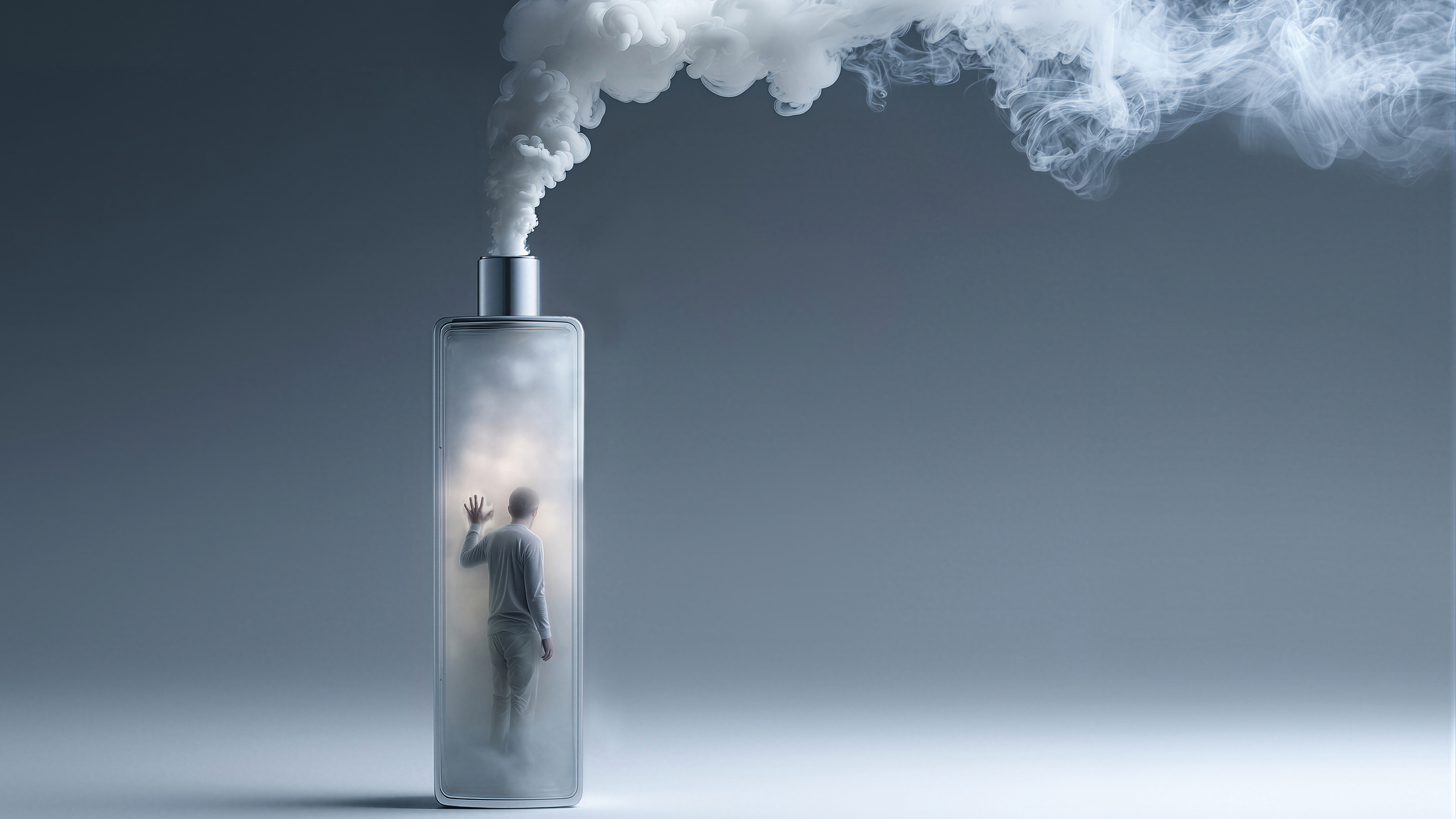
“They used to sleep but little of the night…” (Qur’an 51:17)
In the still hours of the night, long before the first call to dawn, a woman sat alone at the edge of her bed, eyes wide open, listening.
The clock read 2:47 a.m.—the same hour it had each night for as long as she could remember. Decades earlier, in the quiet suburbs of San Jose, she had visited sleep clinics and consulted neurologists in search of an answer. The diagnosis was crisp: Advanced Sleep Phase Syndrome—a circadian rhythm disorder. But to her, it felt like something far older than science could explain. When she first discovered the folklore behind waking at the same hour every night—the so-called witching hour—she wondered if the stories were true. Was she cursed? Was there a whisper from the unseen trying to reach her? Over the years, she gave up asking. The questions were too heavy to carry into the light of day. What she didn’t expect was for this “curse” to resurface—in her grandchildren. When she learned they too had begun to stir awake during the same dark hour, a quiet panic settled over her like the soft shadow of night itself. Was this a legacy she had unknowingly passed down?
Sleep, once considered a simple matter of fatigue and restoration, has become a battleground of modern life. The hum of artificial light, the buzz of notifications, and the demands of ambition have pushed the sacred rhythm of night to the margins. A 2024 study by ResMed reports that 40% of the global population struggles to sleep well at least three nights a week. Yet unlike nutrition or exercise, sleep rarely commands urgent attention—until it fails. More than half of the Japanese population, and nearly half of those in Britain, Australia, and New Zealand, report poor sleep. We are a world that no longer knows how to rest. Yet sleep is not a passive collapse into unconsciousness. It is a divine choreography—a silent, nightly cleansing of mind and soul. To ignore it is to wage war against the very architecture of our being.
In 1964, a college student named Randy Gardner stayed awake for 11 days and 25 minutes in a self-imposed experiment. Monitored by scientists, Gardner hoped to push the limits of human endurance. What he encountered instead was a gradual unraveling: slurred speech, fractured memory, and hallucinations. By the fifth day, he mistook a road sign for a person. By the end, the simple act of forming a sentence became monumental. And yet, with one deep, 14-hour sleep, much of his mind returned to normal. His body forgave him. But his story stands as a stark reminder: sleep is not optional. It is mercy. Scientists now compare prolonged wakefulness to alcohol intoxication. After 17 hours without sleep, the brain functions as if its owner were legally drunk. Reflexes slow, decisions blur, and emotional regulation frays. Still, we continue to dismiss sleep as weakness. As if rest were a luxury the ambitious could not afford. But beneath this cultural narrative lies something quieter, more sacred. Sleep is not just for the body—it is a retreat for the soul.
The brain’s silent janitor
Each day, our minds make hundreds of decisions, process emotions, sort memories, and absorb the world’s endless chatter. Yet every thought leaves a residue—tiny by-products that accumulate like dust in a well-used room. If left unchecked, these microscopic fragments begin to clutter the mind, fog our clarity, and fray our emotional seams. But the brain is not without its janitor. Scientists have discovered a remarkable system called the glymphatic system, a nocturnal cleaning crew of cerebrospinal fluid that flushes away toxins and metabolic waste while we sleep. This elegant mechanism is only fully active during the deepest stages of sleep—particularly when the mind is far from consciousness, when dreams begin to unfurl their surreal scrolls.
When sleep is shortened or fragmented, this detoxification becomes incomplete. The debris remains. We wake not refreshed, but clouded—forgetful, irritable, and often unsure why. Dr. Maiken Nedergaard, one of the pioneers of glymphatic research, likens this nightly cleansing to a dishwasher cycle. The brain, she says, is “washing itself.” And when we skip sleep, we leave the dishes dirty—again and again. It turns out our decision-making power is not infinite. Like a muscle, the brain has only so much capacity each day. If one hundred meaningful choices consume our mental energy, each of those decisions generates by-products that must be cleared. When sleep is poor, these metabolic leftovers remain, and we begin the next day with less clarity than the day before. It is no wonder, then, that chronic sleeplessness can slowly chisel away at the foundations of mental health. Researchers Jessen and Iliff have shown that disrupted glymphatic flow is linked to the buildup of beta-amyloid plaques—the same harmful proteins that are associated with Alzheimer’s disease. What once seemed like an inconvenience—bad sleep—is now understood as a potential accelerant of neurodegeneration.
Waking in the dark: between fear and light
In the folklore of many cultures, waking in the middle of the night—especially at the same hour—has long carried ominous connotations. Some call it the “witching hour,” a time when shadows lengthen and spirits stir. For the woman who lived with her strange sleep pattern, this mythology once wrapped itself around her like a fog. But what if that hour is not a curse, but a calling?
The Qur’an describes a very different vision of the night.
“They used to sleep but little of the night, and in the hours before dawn they would seek forgiveness.” (51:17–18)
“Their sides forsake their beds to invoke their Lord in fear and hope…” (32:16)
These verses do not romanticize insomnia nor encourage reckless sleeplessness. Rather, they speak of intentional wakefulness—a rising from rest, not due to restlessness, but driven by longing. A whisper of devotion cuts through the silence, and the one who rises is both vulnerable and strong.
In the earliest days of Islam, when Prophet Muhammad (peace be upon him) and his followers were few and persecuted, the night became their sanctuary. Their days were filled with persecution; their nights belonged to God. It was under this dark veil that worshippers recited, reflected, and wept softly in secret. The stillness of night offered protection, yes—but it also opened a pathway to clarity and strength. Modern science, surprisingly, echoes the value of this spiritual routine. Neuroscientific studies have shown that during the night, the prefrontal cortex—the seat of rational decision-making—slows down. The emotional centers of the brain, like the amygdala, become more active. This shift makes us more imaginative, more emotionally sensitive, and paradoxically, more vulnerable. It is in these hours that impulsive thoughts, depressive feelings, and even suicidal ideation become more frequent. But it is also in these very hours that worship—a structured, conscious engagement of the self—may serve as a stabilizing force. To rise and pray is to reclaim the night. To seek divine presence is to quiet the storm within. From this perspective, a fragmented night—when filled with purpose—can become a sacred rhythm.
The sacred art of less sleep
It would be tempting to think that rising at night is only for prophets and mystics, but history suggests otherwise. Imam Tabari, one of the greatest historians and Qur’anic commentators, was said to sleep no more than three hours a day. Imam Ghazali, in his youth, was so immersed in his pursuit of knowledge that he slept just long enough to keep his body from collapsing. Imam Bukhari, the celebrated hadith scholar, was known to wake up multiple times each night, lighting a lamp to record a new insight or hadith before returning to sleep. The rhythm of their nights was not shaped by insomnia, but by intention. By love. By longing.
This wasn’t a pattern confined to the Islamic world.
Leonardo da Vinci reportedly practiced a polyphasic sleep schedule, taking 20-minute naps throughout the day in between bursts of invention and sketching. Nikola Tesla, the enigmatic genius behind alternating current, claimed to sleep just two hours a day. Margaret Thatcher, the Iron Lady of British politics, famously got by on four. And Albert Einstein? He valued rest, yes—but he also took daily naps to recharge his mind and imagination.
Were these habits sustainable for everyone? Likely not. But they reveal something deeper: not all wakefulness is the same, and not all sleep is equal. What drives the waking hours—ambition, anxiety, love, or purpose—may matter as much as the hours themselves.
Prophet Muhammad (peace be upon him), whose life was marked by perfect balance, encouraged the qaylulah—a short midday nap. This brief rest, now validated by science, is known to improve memory, focus, and mood. In cultures across the world, from the siesta of Spain to Japan’s inemuri, the art of resting during the day has quietly endured.
The soul, it seems, was never meant to burn through the night in the name of busyness. But it may be called to rise briefly, quietly, to remember.
Of bloodlines and body clocks
The woman who once feared she was cursed had grown used to her strange rhythm of waking. But when her grandchildren began waking at the same hour, that quiet acceptance gave way to unease. Had she passed down a burden rather than a blessing?
Science offered her an unexpected answer.
Dr. Ying-Hui Fu, a neurologist at the University of California, San Francisco, had long been fascinated by families whose sleep cycles defied convention. Through her research, Dr. Fu discovered a rare genetic mutation in the DEC2 gene. People with this mutation are what scientists now call “natural short sleepers”—individuals who function with remarkable clarity and energy on just four to six hours of sleep each night.
Since that first discovery, her team has identified several other gene variants—ADRB1, NPSR1, GRM1—all contributing to a unique orchestration of circadian rhythm, brain chemistry, and internal clocks. These findings have reshaped how we understand sleep—not as a one-size-fits-all phenomenon, but as a deeply personal and biologically complex experience.
Only about 1–3% of people are natural short sleepers. They need less sleep not because of insomnia, but because they are genetically wired that way. What once seemed like misfortune may, in some cases, be a rare genetic gift.
Yet even this discovery leaves a deeper question unanswered: Why are some souls called to wake while the rest of the world sleeps? Perhaps the answer lies not only in our genes, but in the mysterious harmony between biology and purpose.
Where sleep ends and awakening begins
Sleep remains a mystery. We map its stages, trace its brain waves, and sequence its genetic codes—yet its essence eludes capture. It is not simply the absence of consciousness, but the gentle folding of the soul inward, into a realm that borders dreams and eternity.
The Qur’an reminds us:
“It is God who takes away the souls at the time of their death, and those that do not die during their sleep. He keeps those for which He has ordained death and releases the others for a determined term.” — Surah Az-Zumar, 39:42
In this verse, sleep is likened to a temporary death—a sacred pause, a withdrawal of the soul into a space where it is measured, refreshed, or perhaps warned. We awaken each morning not simply because the sun has risen, but because we have been granted return.
Understanding this transforms sleep from a biological necessity into a spiritual encounter. For some, rising in the night may be prompted by genes or habits—but for others, it may be a gentle invitation to listen, reflect, and remember.
The rhythms of sleep are as diverse as the faces of humanity. Some may rise for prayer, others to write, to nurse a child, or to sit in silence and wonder. Some may sleep deeply for eight hours, while others may break their rest into pieces—guided by the mysterious choreography of their internal clocks.
What matters most is not the number of hours, but the meaning we place within them. So whether you find yourself sleepless at night, dozing in the midday sun, or waking just before dawn with a heavy heart—know that these moments are not interruptions. They may be thresholds. A gift from the One who designed us.
Thresholds to insight. To healing. To worship.
To awakening.
“And We made your sleep for rest.” (78:9)
References
Iliff, J. J., Wang, M., Liao, Y., Plogg, B. A., Peng, W., Gundersen, G. A., … & Nedergaard, M. (2012). A perivascular pathway facilitates CSF flow through the brain parenchyma and the clearance of interstitial solutes, including amyloid β. Science Translational Medicine, 4(147), 147ra111. https://doi.org/10.1126/scitranslmed.3003748
Jessen, N. A., Munk, A. S., Lundgaard, I., & Nedergaard, M. (2015). The glymphatic system: A beginner’s guide. Neurochemical Research, 40(12), 2583-2599. https://doi.org/10.1007/s11064-015-1581-6
Xie, L., Kang, H., Xu, Q., Chen, M. J., Liao, Y., Thiyagarajan, M., … & Nedergaard, M. (2013). Sleep drives metabolite clearance from the adult brain. Science, 342(6156), 373-377. https://doi.org/10.1126/science.1241224
He, Y., Jones, C. R., Fujiki, N., Xu, Y., Guo, B., Holder, J. L., Jr., … & Fu, Y. H. (2009). The transcriptional repressor DEC2 regulates sleep length in mammals. Science, 325(5942), 866-870. https://doi.org/10.1126/science.1174443
Shi, G., Xing, L., Wu, D., Bhattacharyya, B. J., Jones, C. R., McMahon, T., … & Fu, Y. H. (2019). A rare mutation of β1-Adrenergic receptor affects sleep/wake behaviors. Neuron, 103(6), 1044-1055. https://doi.org/10.1016/j.neuron.2019.07.026