Six Practices for Building a Global Network Grounded in Faith
Introduction
In many faith traditions, we are called to be in the world, but not of it. That is, we are charged with building communities and serving in ways that reflect our most deeply held beliefs and values, regardless of secular constraints. But as faith-based organizations expand, they experience practical, secular pressures to be more centralized and controlled; to develop processes, procedures and bureaucracy; in short, to operate like secular businesses. This raises a challenging institutional question: How might we organize large-scale faith networks without losing the spirit-led, locally grounded soul of our work?
The Hizmet global network of faith-based service initiatives offers an intriguing answer. Inspired by deep faith commitment to service for the sake of G-d, Hizmet organizations operate service initiatives in more than 180 countries without reliance on central ownership, hierarchy or franchise-type arrangements. Our research into the governance of the Hizmet school network, 1000+ secular schools located in more than 100 countries, identifies six practices that interact to transform shared faith into a growing, sustainable and resilient network of excellent schools [*]. The model explains how interwoven social and spiritual practices can “add up to” shared governance and bottom-up coordination and growth of global faith-based networks. The Hizmet experience illustrates how committed faith communities can animate national and global networks through deep engagement of its community members in the day-to-day governance of faith-based initiatives.
The Hizmet “orchestration from below” model has proven to be remarkably effective at helping the Hizmet network of faith-led service organizations grow, sustain the network, evolve to respond to local needs, and adapt to changing national and global conditions. It offers an exciting model of grassroots faith-in-action that other faith communities might learn from and adapt to their own traditions and structures. In this article, we summarize the orchestration from below model in hopes that the Hizmet example will inspire and inform other global faith-based efforts to heal the world through service.
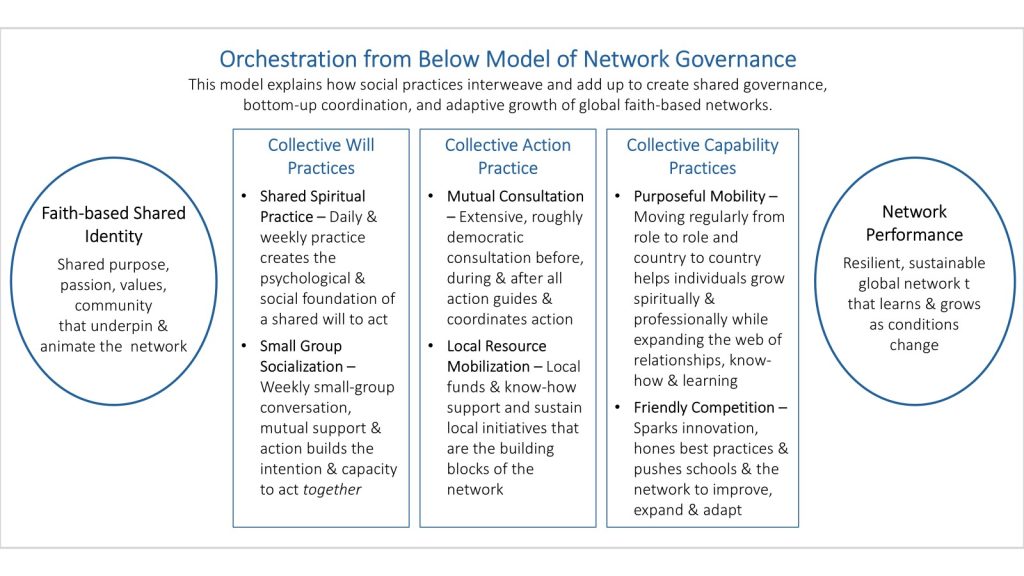
Overview: Orchestration from below model of network governance
The model consists of six social practices that interact to create the collective will to act; to guide, coordinate and sustain collective action at the local level; and to build collective capabilities that enable the network to expand, learn and adapt globally.
Foundation: Faith-based shared identity
The foundation of the orchestration from below model is faith-based shared purpose, passion, values, and community. For Hizmet the shared purpose, passion, values and community are anchored in service to society as the practice and expression of Islam (and increasingly other faith traditions). This faith-based commitment to service creates a fundamental coherence and consistency across Hizmet, even though action is decentralized and orchestration emerges from the ground up.
Collective will practices
1. Shared Spiritual Practice
At the center of the Hizmet school network is commitment to faith-inspired service. The commitment to service is sustained through individual and shared study, prayer, ritual and service. Whether teaching, managing a school, or securing resources, service is an act of altruism and a sacrifice for the pleasure of G-d. Spiritual practice aligns participants around a deeper purpose, reinforces shared identity, and helps create and reinforce the personal and social will to act. Collective action springs from faith-inspired collective identity.
2. Small group socialization
The will to act together is developed and reinforced through weekly gatherings, called sohbets, in which participants worship together, study together and support each other, always with an eye towards turning faith into service and improving collective attempts to serve. These weekly study-worship-action circles provide tremendous spiritual, emotional, and practical support. They also enable participants to accomplish more together than they would separately while also persevering through challenging times. Ongoing collective action depends on the weekly fellowship of friends.
Collective action practices
3. Mutual consultation
To coordinate action locally and across the network, the Hizmet community relies on istişare, or mutual consultation, in which participants seek each other’s counsel before, during and after collective action. The process is a roughly democratic form of communal discernment that emphasizes both full participation and the insight of those with experience. Even if a decision does not work out well, the community remains strong because their commitment to each other is long-term; because decisions are made together; and because mutual consultation emphasizes learning from experience. In the Hizmet school network, mutual consultation is central to every decision involved in starting, operating, expanding and improving a school or network of schools. Coordinated collective action relies on ongoing consultation.
4. Mobilizing local resources
Rather than relying on investors or a central hub for funding, every entity in the network is encouraged to be self-supporting. Although seed funding might come from a combination of sister or brother sohbets, the goal is always to mobilize local resources for ongoing support. Local resources include donations of time, money and expertise from local businesses, parents and community members. Core funding depends on local context: In some countries, schools rely on tuition and in others, on government support available to all schools. By securing and governing resources locally, schools or other initiatives remain attentive to specific local needs; control remains within the community; and each local initiative is insulated from changing conditions elsewhere. Reliance on local resources supports and protects the fruits of collective action while enabling the network to expand its resource base as it expands its reach.
Collective capability practices
5. Purposeful mobility
Inspired by the concept of hijrat, that is a spiritual journey requiring a leap of faith, teachers and leaders visit other schools often and periodically move to schools in different countries. They also move from schools to other Hizmet organizations, and vice versa. For individuals, hijrat is an important part of personal, professional and spiritual development. For the network, ongoing mobility builds a web of connections throughout the network and around the world; creates pathways for cross-location collaboration and learning; and helps to spread innovations and best practices within countries and across the globe. Similarly, sparks fly when purposeful mobility occurs across different types of organizations. For example, when a director of a dialogue organization becomes a school’s outreach coordinator or alumni director, the knowledge, networks, and expertise gained at the dialogue center helps the school reach and draw from a broader set of people, skills and resources. The result of purposeful mobility is dynamic, evolving set of connections and capabilities that help the network grow, sustain, expand and evolve without a central coordinator. Purposeful mobility creates the collective capability of connection required to make a network dynamic and responsive to changing conditions locally and around the world.
6. Friendly competition
Within the network, schools emulate especially high-performing schools as they strive to improve every dimension of service through education, including teaching, administration, student support, support for other schools, resource acquisition and more. Friendly competition inspires innovation while creating a collective faithful striving to improve, learn from others and emulate best practices. When one school finds a better way to serve, friendly competition encourages others to match that excellence, and then to contribute its own improvement to the network. In turn, the collective commitment to learn from each other and to improve every school fuels continuous improvement and adaptability of the network itself. Friendly competition is the motivating force behind the collective capability to pursue network excellence, innovation and change.
Reflective shared governance
Effective orchestration from below depends on concerted effort to implement and practice all six practices. Shared spiritual practice and small group socialization are effective ways to build shared identity and intention – but will not necessarily create effective coordinated action. Effective collective action requires resources and coordination, and mutual consultation and local mobilization of resources enable bottom-up collective action. Finally, a loose collection of local initiatives does not make a living, breathing network; that takes broader coordination and the transfer of knowledge and innovation. Purposeful mobility and friendly competition help knit together a global network while inspiring continuous improvement and adaptation.
At the same time, because every faith community is unique, with its own spiritual springs, culture and ways of organizing, the practices cannot be applied mechanically. Instead, they must be adjusted over time to match the particular ethos and structure of each faith community. This requires continual reflection about whether and to what degree the community is committed to orchestration from below; is implementing the practices in good faith; and is learning from experience to adjust the practices to their shared traditions and changing reality. These reflections can become part of spiritual practice, small group socialization and mutual consultation: What is working well and not so well as we practice shared governance? They can also become part of local mobilization of resources, purposeful mobility and friendly competition: What can we learn from our colleagues that will improve both our own efforts and our collaboration across the network?
For example, as Hizmet expands beyond its Turkish roots to settle into and include participants from many countries, it has become increasingly important to expand its circles of consultation and action and to embrace individuals with a knack for listening, learning and translating across culture, language and even faith traditions – all with a critical assist from shared spiritual commitments to service. At the same time, the practice of visiting and the competitive drive to innovate and improve has become ever more important as each local community struggles to find ways to provide and sustain faith-based service in new and often challenging settings.
Towards a sustainable, resilient, evolving, expanding global network of faith-based action
Shared faith and shared service build unity and support across distance and difference. Mutual listening and learning combine with local resources to develop and sustain local initiatives; to provide protection against cooptation; and to build resilience in the face of secular pressures. Mobility and friendly competition inspire innovation, expansion, adaptation and change. Ongoing prayerful reflection builds commitment to and skill in orchestration from the bottom up. By incorporating these practices in reflective ways, we believe that many faith networks can transform shared faith into collective intention, collective action and collective capability to heal the world.
* For a full report of the research on which this summary is based, please see Hill, T., Svystunova, L., Du, X. 2026. Orchestration from below: Uncovering the social practices underpinning relational governance of global inter-organizational networks. Journal of International Management, 32(5): 101403. https://doi.org/10.1016/j.intman.2026.101403
Queries: Is Your Faith Community Ready for Orchestration from Below?
- What parts of our faith tradition call us to service? Encourage global reach? Are we called to undertake collective action in service of G-d?
- What spiritual practices strengthen our commitment to service and collective action? Are we practicing these regularly? How might we make these practices part of our daily and weekly routines?
- Are we in the habit of meeting regularly for spiritual fellowship and to support personal and collective acts of service? How might we make these meetings a central part of our lives?
- Do we have the tradition and skills of listening carefully to each other, inviting feedback, and deciding together about actions to take? Do we foster a culture of curiosity, forgiveness and learning from experience? How might we strengthen our commitment to and practice of mutual consultation?
- What role does visiting, or even working with, faith-based service efforts within and beyond our country’s borders play in personal, professional and spiritual development? How might we enable hijrat in our community?
- How do we encourage each other to innovate and emulate? What might friendly competition look and feel like within our community, culture and traditions? How might we foster competition that is collaborative and supportive?
- Can we commit to practicing the six practices that enable orchestration from below? How might we need to adapt them, while maintaining their essence, to fit our community, culture and traditions? What resources or skills might we need to develop to adapt and practice these mechanisms? How might we reflect on and learn from our efforts to do so?
- What is the first step to increasing the practice of shared governance in our faith community?